Les auteurs ne travaillent pas, ne conseillent pas, ne possèdent pas de parts, ne reçoivent pas de fonds d'une organisation qui pourrait tirer profit de cet article, et n'ont déclaré aucune autre affiliation que leur organisme de recherche.
University of California, Los Angeles apporte un financement en tant que membre adhérent de The Conversation US.
Voir les partenaires de The Conversation France
Editor’s note: On April 2, 2018, the Trump administration froze the fuel efficiency standards for cars and light-duty trucks, following the EPA’s finding earlier this year that tailpipe emissions standards negotiated by the Obama administration for motor vehicles built between 2022 and 2025 were set “too high.”. The EPA also revoked California’s historic ability to adopt standards that are more ambitious than the federal government’s. UCLA legal scholars Nicholas Bryner and Meredith Hankins explain why California has this authority – and what may happen if the EPA tries to curb it.
The Clean Air Act empowers the EPA to regulate air pollution from motor vehicles. To promote uniformity, the law generally bars states from regulating car emissions.
But when the Clean Air Act was passed, California was already developing innovative laws and standards to address its unique air pollution problems. So Congress carved out an exemption. As long as California’s standards protect public health and welfare at least as strictly as federal law, and are necessary “to meet compelling and extraordinary conditions,” the law requires the EPA to grant California a waiver so it can continue to apply its own regulations. California has received numerous waivers as it has worked to reduce vehicle emissions by enacting ever more stringent standards since the 1960s.
Other states can’t set their own standards, but they can opt to follow California’s motor vehicle emission regulations. Currently, 12 states and the District of Columbia have adopted California’s standards.
In the 1950s scientists recognized that the unique combination of enclosed topography, a rapidly growing population and a warm climate in the Los Angeles air basin was a recipe for dangerous smog. Dutch chemist Arie Jan Haagen-Smit discovered in 1952 that worsening Los Angeles smog episodes were caused by photochemical reactions between California’s sunshine and nitrogen oxides and unburned hydrocarbons in motor vehicle exhaust.
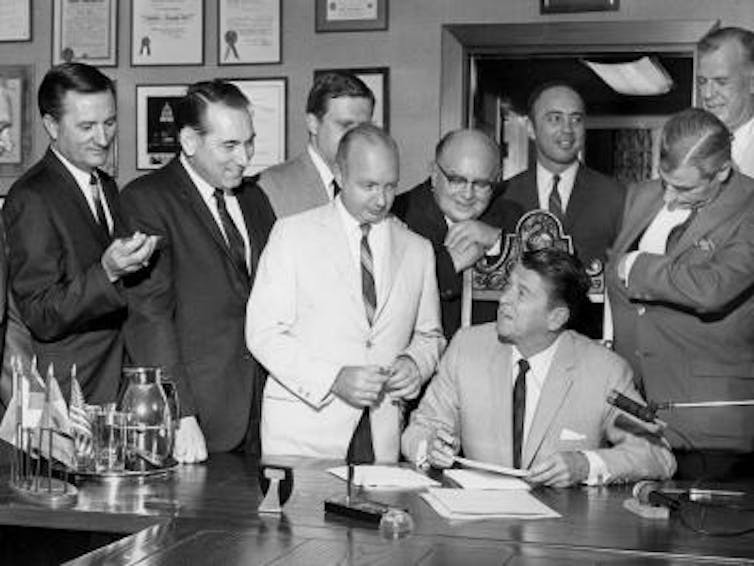
California’s Motor Vehicle Pollution Control Board issued regulations mandating use of the nation’s first vehicle emissions control technology in 1961, and developed the nation’s first vehicle emissions standards in 1966. Two years later the EPA adopted standards identical to California’s for model year 1968 cars. UCLA Law scholar Ann Carlson calls this pattern, in which California innovates and federal regulators piggyback on the state’s demonstrated success, “iterative federalism.” This process has continued for decades.
The EPA has never attempted to revoke an existing waiver. In 2007, under George W. Bush, the agency denied California’s request for a waiver to regulate motor vehicle GHG emissions. California sued, but the EPA reversed course under President Obama and granted the state a waiver before the case was resolved.
California’s current waiver was approved in 2013 as a part of a “grand bargain” between California, federal agencies and automakers. It covers the state’s Advanced Clean Cars program and includes standards to reduce conventional air pollutants like carbon monoxide, nitrogen oxides and particulate matter, as well as the GHG standards jointly developed with the EPA and DOT.
The Trump administration is threatening to revoke this waiver when it decouples the national GHG vehicle standards from California’s standards. EPA Administrator Pruitt has said that the agency is re-examining the waiver, and that “cooperative federalism doesn’t mean that one state can dictate standards for the rest of the country.” In our view, this statement mischaracterizes how the Clean Air Act works. Other states have voluntarily chosen to follow California’s rules because they see benefits in reducing air pollution.
Gov. Jerry Brown, Attorney General Xavier Becerra and California Air Resources Board Chair Mary Nichols have all made clear that the state will push back. It’s almost certain that any attempt to revoke or weaken California’s waiver will immediately be challenged in court – and that this would be a major legal battle.
